The Brain’s Communication Network
Your brain isn’t a single “thing.” It’s a network and a staggeringly complex one. And the basic unit of that network is the neuron: a specialized cell built for one job, sending messages.
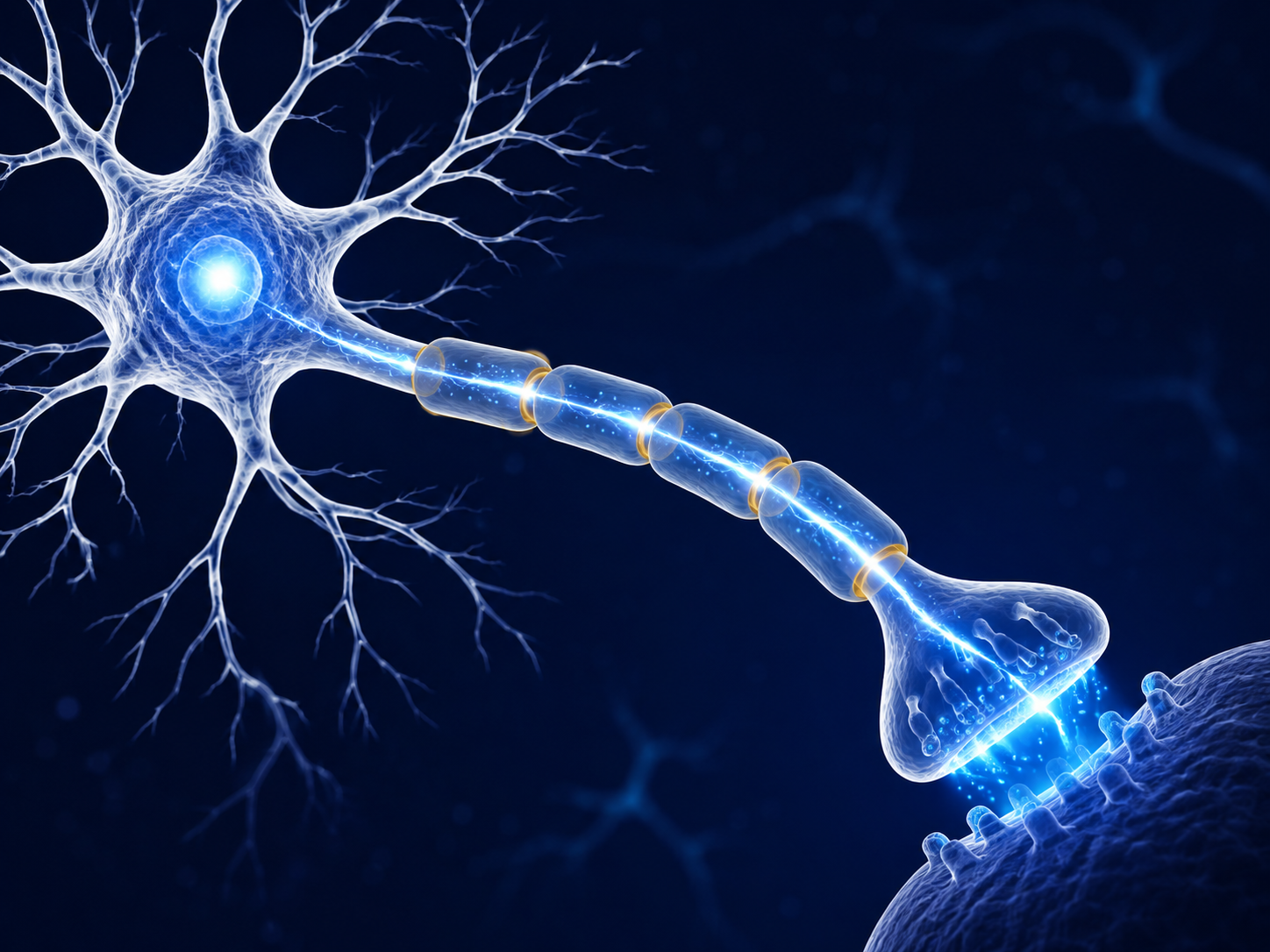
Neurons come in different shapes and sizes, but they share the same basic structure: a cell body (called the soma), branch-like arms called dendrites that receive incoming signals, and a long tail called an axon that sends signals out.
Think of it like a tree. The roots (dendrites) collect information from the environment. The trunk (axon) carries the message outward. And at the tips of the branches? That’s where things get really interesting.
How a Message Enters a Neuron
When a neighboring neuron fires, it releases chemical messengers into the space between cells. Those messengers float across the gap and land on your neuron’s dendrites, binding to receptor sites like a key sliding into a lock.
Each signal that lands causes a small electrical change inside the neuron. Some signals are excitatory — they push the neuron toward firing. Others are inhibitory — they hold it back.
Your neuron is constantly doing math. It’s adding up all the excitatory nudges and subtracting all the inhibitory ones. The question is: does the total reach the magic number?
Threshold and the All-or-Nothing Principle
That magic number is called the threshold — the minimum level of stimulation a neuron needs before it fires. And here’s the thing: neurons don’t do “sort of firing.”
Either the signal reaches threshold, and the neuron fires at full strength, or it doesn’t fire at all. This is the all-or-nothing principle. A stronger stimulus doesn’t make an individual neuron fire harder. It makes more neurons fire, or makes them fire more frequently.
It’s like a gun trigger. You either pull it enough to fire the bullet, or you don’t. Half-pulling doesn’t get you half a bullet.
Action Potentials Explained
When a neuron hits that threshold, it generates an action potential — a rapid, electrical signal that travels the full length of the axon.
Here’s what happens at the cellular level: sodium ions rush into the neuron, causing a sudden spike in electrical charge (depolarization). Then potassium ions rush out, resetting the charge (repolarization). In a fraction of a second, the neuron returns to its resting state and is ready to fire again.
This spike of electricity travels down the axon like a wave — relentlessly, in one direction only.
The Axon, Myelin, and Signal Speed
Speed matters in the brain. If your hand touches something hot, you need that message reaching your brain (and back to your muscles) fast.
That’s where myelin comes in. Myelin is a fatty coating that wraps around the axon in segments, like insulation on an electrical wire. It forces the action potential to “jump” from gap to gap (nodes of Ranvier) rather than to propagate slowly along the entire length. This dramatically increases transmission speed.
Healthy myelin = fast, efficient signals.
This is also why diseases that attack myelin, like multiple sclerosis, are so disruptive. When the insulation breaks down, signals slow down, misfire, or don’t arrive at all.
The Synapse: Where Signals Stop (and Start Again)
The action potential races to the end of the axon — to a structure called the axon terminal. But it can’t cross directly into the next neuron. There’s a tiny gap in the way.
That gap is called the synapse (specifically, the synaptic cleft).
When the electrical signal hits the axon terminal, it triggers the release of neurotransmitters — tiny chemical messengers stored in little sacs called vesicles. Those neurotransmitters flood into the synaptic cleft and drift toward the receiving neuron’s dendrites.
And the process starts over. Electrical → chemical → electrical.

Meet the Neurotransmitters
Neurotransmitters are the brain’s chemical vocabulary. Different ones carry different messages. Here are the major players:
Dopamine — involved in reward, motivation, and movement. When you accomplish something and feel that “yes!” moment? Dopamine. It’s also heavily implicated in addiction (more on that another time).
Serotonin — regulates mood, sleep, and appetite. Low serotonin levels are associated with depression. This is the neurotransmitter targeted by SSRIs (we’ll get to that in a second).
Norepinephrine — your brain’s alertness chemical. Part of the fight-or-flight response. When you’re startled awake at 3am by a noise, norepinephrine is part of what floods your system.
GABA (gamma-aminobutyric acid) — the brain’s main inhibitory neurotransmitter. It slows things down. Anti-anxiety medications often work by boosting GABA activity.
Glutamate — the brain’s main excitatory neurotransmitter. It speeds things up. Plays a massive role in learning and memory.
Acetylcholine — involved in muscle movement, memory, and attention. Loss of acetylcholine-producing neurons is linked to Alzheimer’s disease.
Lock-and-Key Receptors
Not every neurotransmitter works on every neuron. Receptors are specific — they only accept certain neurotransmitters. The match has to be precise.
Think of a lock and key. Serotonin fits serotonin receptors. Dopamine fits dopamine receptors. If the shapes don’t match, there’s no binding, no message, no effect.
This specificity is also why drugs — both therapeutic and recreational — can be so powerful. Many of them work by mimicking neurotransmitters, blocking receptors, or flooding the system with a chemical that happens to fit a particular lock.
Reuptake and How SSRIs Work
Once a neurotransmitter has done its job in the synapse, it doesn’t just hang around forever. The releasing neuron pulls it back in — a process called reuptake — so it can be recycled and used again.
Here’s where SSRIs (Selective Serotonin Reuptake Inhibitors) come in. SSRIs — medications like fluoxetine (Prozac) and sertraline (Zoloft) — work by blocking the reuptake of serotonin. If serotonin can’t be pulled back, it stays in the synapse longer, giving it more time to bind to receptors and keep doing its job.
This doesn’t “create” more serotonin. It just gives what’s already there more time to work.
It’s a subtle distinction — but an important one when you’re actually trying to understand how these medications function, versus what you might hear in a simplified “low serotonin = depression” explanation.
How Messages Travel Through the Brain
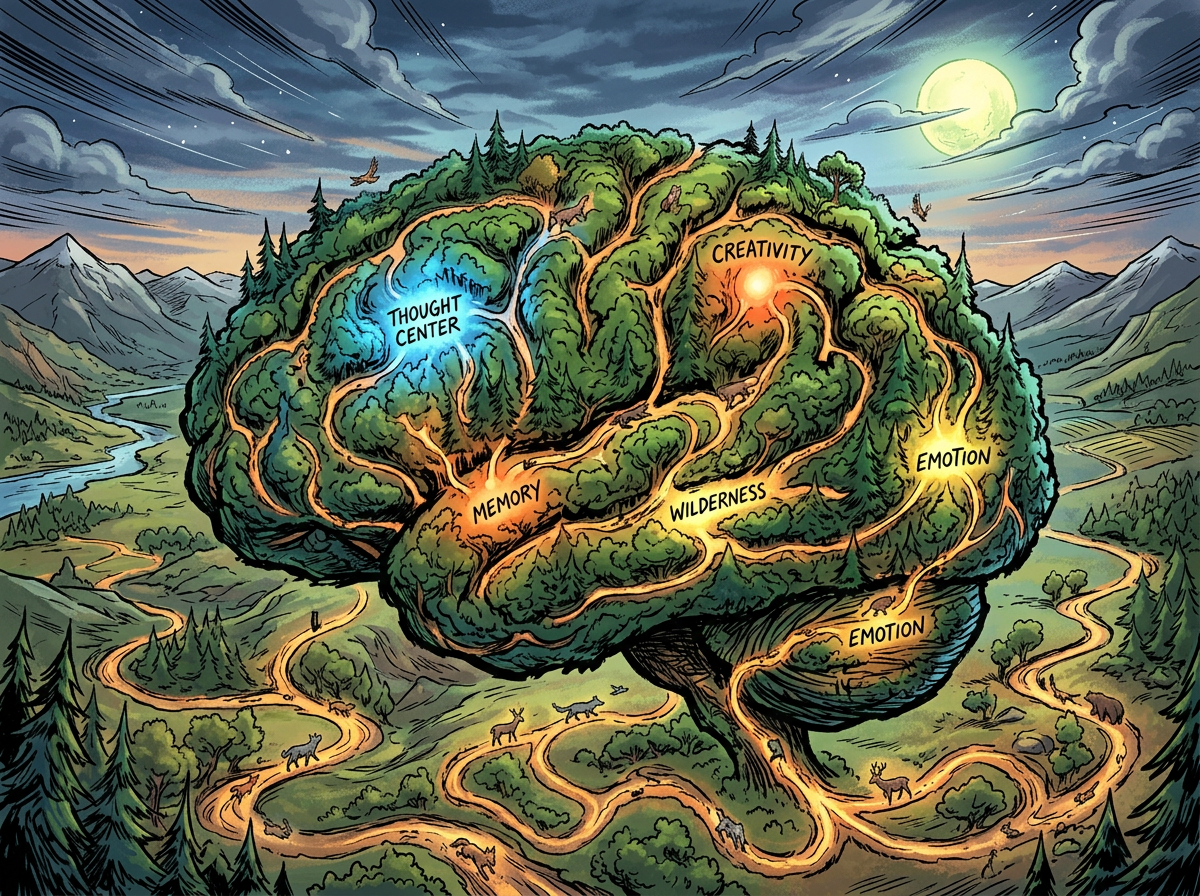
No single neuron handles a thought or emotion on its own. Signals travel through neural pathways — long chains of neurons that fire in sequence, passing the message along.
The more often a pathway fires, the stronger and more efficient it becomes. Myelin builds up. Synaptic connections strengthen. The signal moves faster and with less effort.
This is the biological mechanism behind neuroplasticity — the brain’s ability to change and reorganize based on experience. As we say in neuroscience: neurons that fire together, wire together.
That’s not just a catchy phrase. It’s literally how habits form, how you learn a language, how trauma reshapes threat responses, and how therapy can rewire thought patterns over time.
Want to go deeper on this? Check out Your Brain Is Rewiring Right Now — Here’s What That Means for a closer look at neuroplasticity in action.
The Takeaway
Every thought you’ve had today ran through this system. Electrical signals, chemical messengers, gaps too small to see — all working together in milliseconds, billions of times per second.
Neurons aren’t just biology trivia. They’re the substrate of every emotion, memory, decision, and habit you have. Understanding them isn’t just interesting — it’s actually useful for understanding yourself.
🧠 Want to study this faster? Grab the Mega Psychology Flashcard Pack — 318 illustrated terms across 24 chapters, instant download for $9.