Ever wonder if you can really trust psychology research?
Before we dive in, let’s break down how psychologists actually study people…the right way.
Welcome to Lesson 3 in Psych 101
This expanded lesson will walk you through:
- The scientific method
- Different research methods psychologists use
- Why “correlation ≠ causation” is the golden rule
- How ethical guidelines protect participants
- How psychologists choose the right tool for the job
By the end, you won’t just understand psychological research — you’ll be able to think like a psychologist.
Let’s begin with a mystery…
The Case of the Missing Pizza Slice
Last week, a slice of pizza mysteriously disappeared from the psychology lab refrigerator. I asked you to vote on the prime suspect.
Your top choices:
- #1: The Gym Bros
- #2: The Janitor
- #3: The Sleep-Deprived Grad Student
But here’s the thing…
A psychologist does not jump to conclusions.
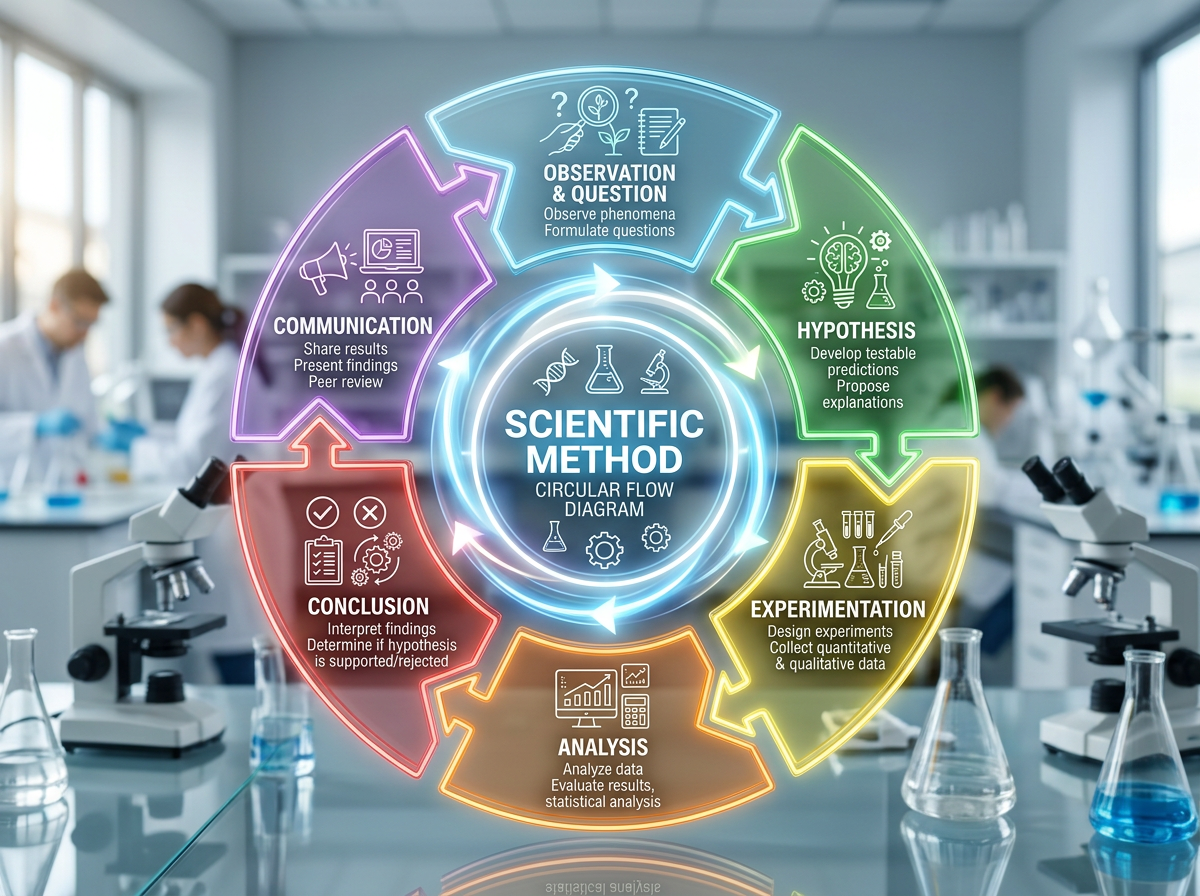
Instead, they use the scientific method, the backbone of psychological research.
Let’s break it down step by step — using the pizza mystery as our running example.
Step 1 — Observation: “What’s Happening Here?”
Before making predictions, psychologists begin with systematic observation.
We don’t guess.
We don’t assume.
We observe.
Our observations:
- The pizza is gone
- The box is open
- There are crumbs on the counter
- Foot traffic around the fridge increased during lunch hours
We simply notice what is, without interpretation.
This is the foundation of all science.
Step 2 — Ask a Question
Observation leads to curiosity.
Curiosity leads to a question.
But instead of:
“Who stole the pizza?”
…which is too broad…
Psychologists ask testable questions, like:
“What factors in a shared workspace increase the likelihood of someone consuming communal food?”
This reframes a blame-oriented question into a scientific one.
Step 3 — Form a Hypothesis
A hypothesis is:
- Specific
- Measurable
- Falsifiable (meaning it can be proven wrong)
Based on your community votes, we could guess:
“The janitor ate the pizza.”
But that’s not testable in a scientific way.
So we refine it into a condition-driven hypothesis:
“If a person is experiencing high stress, then they are more likely to eat communal food.”
Why this works:
- It identifies a cause (stress)
- It predicts an effect (pizza consumption)
- It can be tested and disproven
A good scientific hypothesis always allows for the possibility of being wrong.
Step 4 — Identify and Define Variables
To test anything scientifically, we need clarity.
Independent Variable (IV)
The thing we manipulate.
Example: Stress level
Dependent Variable (DV)
The thing we measure.
Example: Amount of pizza eaten
But vague terms won’t work.
So psychologists use operational definitions — clear, concrete, measurable definitions.
Operationalizing our variables
- “High stress” = Scoring above 15 on the Perceived Stress Scale
- “Pizza consumption” = Number of slices missing between 9 a.m. and 5 p.m.
This precision is what separates science from guessing.
Choosing the Right Research Method

Now that we have a hypothesis, we need a method.
Psychologists use multiple research tools depending on:
- The question
- The population
- Ethical boundaries
- Practical constraints
Let’s explore them using our pizza case.
1. Naturalistic Observation
Watching behavior in its natural environment
We could hide a camera near the fridge to see who’s grabbing the slices.
Strengths:
- Authentic behavior
- No manipulation
- Real-world setting
Weakness:
- Reactivity: people act differently when they know they’re being watched
If the thief sees the camera, they might suddenly become… disciplined.
2. Surveys and Self-Report
We could email a questionnaire to everyone in the department.
Strengths:
- Quick
- Easy
- Collects lots of data
Weaknesses:
- Social desirability bias
“Gym bros” may insist, “I don’t eat carbs,” even if they do. - Memory errors
- People may lie (intentionally or unintentionally)
Not ideal for uncovering pizza crimes.
3. Case Studies
A deep dive into one individual
We could study our top suspect for weeks:
- Stress patterns
- Eating habits
- Daily routine
Strengths:
- Extremely detailed
- Rich insight
Weakness:
- Poor generalizability
What’s true for one person may not apply to others.
4. Correlational Research
Looking for relationships between variables
We could track:
- Daily stress levels
- Number of missing pizza slices
If both go up together → positive correlation
If one goes up while the other goes down → negative correlation
The Golden Rule
Correlation does NOT equal causation.

Just because two things move together does not mean one causes the other.
Maybe the real cause is:
- Deadlines
- Low morale
- Free-food Fridays
Correlation is useful, but limited.
5. Experiments — The Gold Standard
Experiments are the ONLY method that can prove cause and effect.
Our experimental design:
Experimental group: High stress
We tell them a surprise pop quiz starts in 10 minutes.
Control group: Low stress
We let them relax and watch cat videos.
Both groups then receive access to the same pizza.
We measure who eats more.
Why experiments work
- We manipulate the independent variable
- We control all other factors
- We use random assignment
- We eliminate guesswork
This lets us say:
“High stress increases pizza consumption.”
But before we run the study, we must address…
Research Ethics: The Invisible Backbone of Psychology
Psychological research follows strict ethical guidelines, as outlined in the Belmont Report and enforced by Institutional Review Boards (IRBs).

Here are the major principles:
1. Informed Consent
Participants must:
- Know they’re in a study
- Understand what will happen
- Agree voluntarily
No hidden cameras. No surprises (unless ethically justified and approved).
2. Confidentiality
Psychologists must protect participant identity.
No papers titled:
“Dr. Smith: The Pizza Thief.”
Data must be anonymized and stored securely.
3. Protection from Harm
Researchers must avoid:
- Physical harm
- Emotional distress
- Psychological trauma
Even telling someone they have a “pop quiz in 10 minutes” could require IRB discussion.
Ethical Research Asks:
Do the benefits outweigh the risks?
If not, the study cannot be approved — even if it’s scientifically sound.
Lesson Recap
Today we learned:
- Psychologists follow the scientific method
- They form testable, falsifiable hypotheses
- They define variables with operational precision
- They use different research methods depending on the question
- Only experiments establish causation
- All research must follow strict ethical guidelines
This is what makes psychology a science, not guesswork.
Up Next: Nature vs. Nurture
In Lesson 4, we tackle one of psychology’s biggest debates — how much of who you are comes from biology, and how much from your environment.
Course Textbook
For this Psych 101 series, I reference Discovering Psychology: The Science of Mind. You can find it here: https://amzn.to/4qYYDBd
As an Amazon Associate, I earn from qualifying purchases at no extra cost to you. This helps support my work creating free psychology content. Thank you!
🧠 Want to study this faster? Grab the Mega Psychology Flashcard Pack — 318 illustrated terms across 24 chapters, instant download for $9.
Meet Your Instructor

Desiree Clemons, M.A. Psychology
Hi, I’m Desiree, an educator, researcher, and creator of The Psychology Notebook. I share clear, accessible psychology lessons to help students and self-learners understand the mind with confidence.